Why Composite Fillings Are Better Than Metal (In Most Cases)
Posted on 12/7/2025 by SRD Russellville |
 For most modern cases, tooth-colored composite fillings have become the better choice over traditional silver amalgam fillings, and they are now the standard of care at most practices including ours. That does not mean amalgam was a bad material. It served the field for more than 150 years and is still doing its job in countless mouths today. But the bonding chemistry, the aesthetic expectations, and the emphasis on conserving healthy tooth structure have all shifted, and for the vast majority of cavities we treat at our Russellville office, composite is simply the better choice. For most modern cases, tooth-colored composite fillings have become the better choice over traditional silver amalgam fillings, and they are now the standard of care at most practices including ours. That does not mean amalgam was a bad material. It served the field for more than 150 years and is still doing its job in countless mouths today. But the bonding chemistry, the aesthetic expectations, and the emphasis on conserving healthy tooth structure have all shifted, and for the vast majority of cavities we treat at our Russellville office, composite is simply the better choice.
This post walks through the honest case for composite over amalgam, where the older silver material still had a small edge, and when a dental filling is not actually the right answer at all and an inlay, onlay, or crown should be on the table. The goal is to help you make a clear decision the next time a cavity is found, not to talk you into anything.
On This Page
A Quick Look at Amalgam’s History
Dental amalgam has been used to fill cavities since the 1830s. It is a metal alloy that combines roughly half elemental mercury with silver, tin, copper, and small amounts of other metals. Mixed at chairside or premeasured in capsules, the soft amalgam is packed into a prepared cavity, where it hardens into a strong, durable restoration.
The reasons amalgam dominated for so long are straightforward. It was inexpensive, forgiving to place even in challenging conditions, and remarkably durable in large posterior restorations. Many silver fillings placed in the 1970s and 1980s are still in patients’ mouths today, doing their job without complaint.
So why has the field largely moved on? Three things changed. Bonding chemistry improved dramatically, so newer composite materials adhere to tooth structure in a way amalgam never could. Patient expectations around appearance shifted, and the visible silver line on a back tooth started bothering more people. And the profession has put renewed emphasis on conservation of healthy tooth structure, which is something composite supports and amalgam works against by design.
Why Composite Has Become the Default
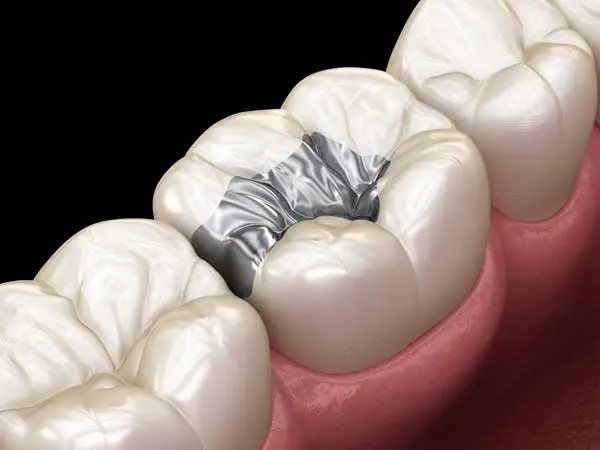 The advantages of composite are not really about marketing. They reflect real differences in how the material interacts with your tooth. The advantages of composite are not really about marketing. They reflect real differences in how the material interacts with your tooth.
Appearance that disappears into the smile. Composite is matched to your natural tooth shade and is essentially invisible after placement. This matters even on back teeth, which show during laughter, yawning, and eating. The cosmetic dentistry benefit is real, but the bigger point is that there is no longer a trade-off between aesthetics and a quality restoration on a molar.
Conservation of healthy tooth structure. Amalgam fillings rely on a mechanical grip to stay in place, which means the dentist has to cut additional undercuts into the tooth even where there is no decay. Composite bonds directly to enamel and dentin, so we only have to remove what is actually decayed. Over a lifetime of restorations and replacements, that difference adds up to a meaningful amount of preserved tooth.
No long-term metal expansion. Amalgam expands and contracts with temperature changes from hot and cold foods over decades. That movement has been associated with cracks forming in the surrounding tooth in some cases. Composite is more dimensionally stable, putting less stress on the structure that surrounds it.
Mercury-free for patients who prefer it. Mainstream research and major dental organizations consider amalgam safe for the general adult population, but the FDA has issued more cautious guidance for specific groups including pregnant women, nursing mothers, young children, and people with mercury allergies or kidney impairment. Composite is an obvious choice for any patient who prefers to avoid amalgam regardless of the broader safety question.
Easier to repair without starting over. If a composite filling chips at the edge or develops a small problem at the margin, we can often add to or refresh the restoration without removing the entire filling. Amalgam typically has to be removed and replaced in full when it fails.
The Honest Trade-Offs
A fair discussion of composite has to acknowledge where amalgam still had a slight edge, because pretending otherwise undermines the rest of the conversation.
Amalgam has historically performed better in very large posterior restorations under heavy chewing loads, particularly when the cavity extends below the gumline and keeping the area perfectly dry during placement is difficult. Composite is technique-sensitive. It requires a dry field, careful layering, proper curing, and an experienced hand to get the long-term result that the material is capable of delivering. When all of those conditions are met, modern composite performs comparably to amalgam in most situations. When they are not, composite can fail earlier than amalgam would have.
This is part of why patients with very old amalgams are often advised to leave them alone if they are sound. There is no clinical benefit to replacing a functional silver filling just because it is silver, and every replacement removes a little more tooth structure. We will recommend replacement when the filling is failing, when there is decay around the margins, or when a patient specifically requests it for appearance reasons.
When Other Options Fit Better
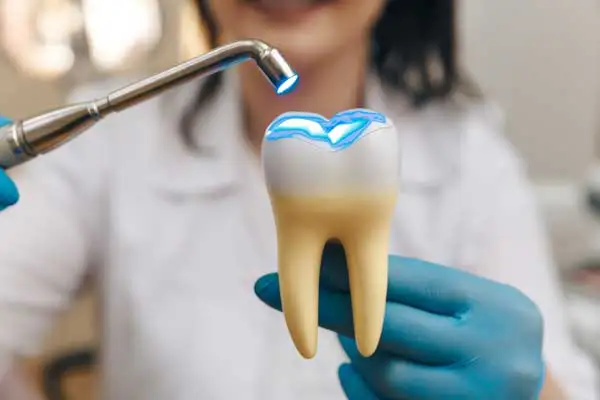 Sometimes the right answer is neither composite nor amalgam. When a cavity is very large, when a tooth has had multiple previous restorations, or when a fracture is involved, a different category of restorative dentistry may be the better path. Sometimes the right answer is neither composite nor amalgam. When a cavity is very large, when a tooth has had multiple previous restorations, or when a fracture is involved, a different category of restorative dentistry may be the better path.
Inlays and onlays sit in the middle ground between a filling and a crown. They are custom-made in porcelain or another durable material outside the mouth, then bonded into the prepared tooth. For a tooth that needs more support than a filling can provide but where a full crown would remove too much healthy structure, an inlay or onlay can preserve more of the natural tooth while delivering crown-level durability. The crown versus inlay or onlay decision is worth its own conversation when a tooth is on the borderline.
A full dental crown enters the picture when the remaining tooth structure is too compromised to support any kind of internal restoration. Crowns also make sense after root canal treatment on a back tooth, when the goal is to protect what remains from fracture under chewing forces. None of this means a simple cavity needs anything more than a filling. It just means we have more options than fillings, and we use them when they are appropriate.
Talking With Our Russellville Team
If you have a cavity that needs to be filled or an old amalgam you have been thinking about replacing, the conversation is worth having in person at Singing River Dentistry in Russellville, AL. We can show you what is going on with the tooth and walk through which material genuinely fits your situation. Call our office at 256-332-6888 or visit our Russellville home page to schedule a visit, and we will give you straight answers rather than a sales pitch.
Frequently Asked Questions
Are silver amalgam fillings unsafe because of the mercury?
Mainstream research and major dental organizations consider amalgam safe for the general adult population. The FDA has issued more cautious guidance for certain groups, including pregnant women, nursing mothers, young children, and people with mercury allergies or kidney impairment. For most patients, a sound existing amalgam filling does not need to be removed for safety reasons.
Will my insurance cover composite fillings the same as amalgam?
Coverage varies by plan. Some insurance plans reimburse composite at the same rate as amalgam, others pay the amalgam rate and leave the difference to the patient on back teeth, and some cover composite without restriction. Our front desk can verify your specific coverage before treatment so there are no surprises.
Do composite fillings stain over time?
Modern composites resist staining well, though the very edges of a filling can pick up some discoloration over the years from coffee, tea, red wine, and tobacco. Polishing at routine cleanings handles most of this, and a filling can be refreshed or replaced if it becomes noticeable.
Should I replace my old silver fillings just for appearance?
If a silver filling is sound and there are no signs of decay around it, there is no clinical reason to replace it. Some patients do choose to replace visible amalgams for cosmetic reasons, which is a reasonable decision. We will give you a straightforward read on what each filling looks like and let you make the call.
How long do composite fillings last?
Well-placed composite fillings typically last around ten years or more, and many last considerably longer. Longevity depends on the size and location of the filling, your bite forces, whether you grind your teeth, and how well the area is maintained at home and at routine cleanings.
|
|

